Relocating, California, and Guns
By Sean E. Russell on on Permalink.
Yeah, so. Once upon a time, I lived in Oregon and bought my first pistol. Then somehow it became my wife’s gun and I was gunless.
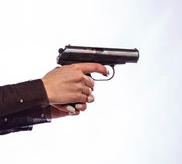 (Not my wife, not her gun)
Then I changed jobs and moved to Pennsylvania, and bought a bunch more – a couple rifles, and a few more pistols, and a revolver. While in PA, I also got a license to carry and did that off and on for a bit, but more off than on because my reason for having guns was that I like to shoot.
After many years, we moved to Minnesota, and while I didn’t buy more guns, when I moved I called the county cops and asked if I needed to report my inventory or something. I could tell the guy on the other end of the line was bemused, or amused, but he said, no. It in Minneapolis that I discovered that a lot of people around the metro area own Really Big Handguns because it’s illegal to hunt with any long gun other than a smooth-bore. I don’t think that’s true outside of the greater Minneapolis region, but I saw a lot of hand canons at the range.
Early this year, we moved to California. Warned by the plethora of memes and snide comments online, before we moved I checked if I could bring any of my guns with me and discovered – to my surprise – that only a single long gun qualified as an “assault rifle” and I wouldn’t be able to “import” it. And this is where the story really starts.
First, my one firearm that California considers an assault rifle is a KelTec RFB, which has several of the no-no features. The barrel is plenty long enough, but the overall length is 0.5” too short – California law is really unwelcoming for as bullpup fans. CA doesn’t like bullpups so much it appears one of the characteristics was included specifically to target the PS90 (“thumbhole stock”, although a PS90 is probably far too short anyway). So I left my RFB in locked storage in MN until we move somewhere it’s legal, or until I decide to sell it. Either could happen; I don’t have an emotional attachment to any of my guns (except maybe Bessie, my revolver – I could never betray her like that, she’s sensitive).
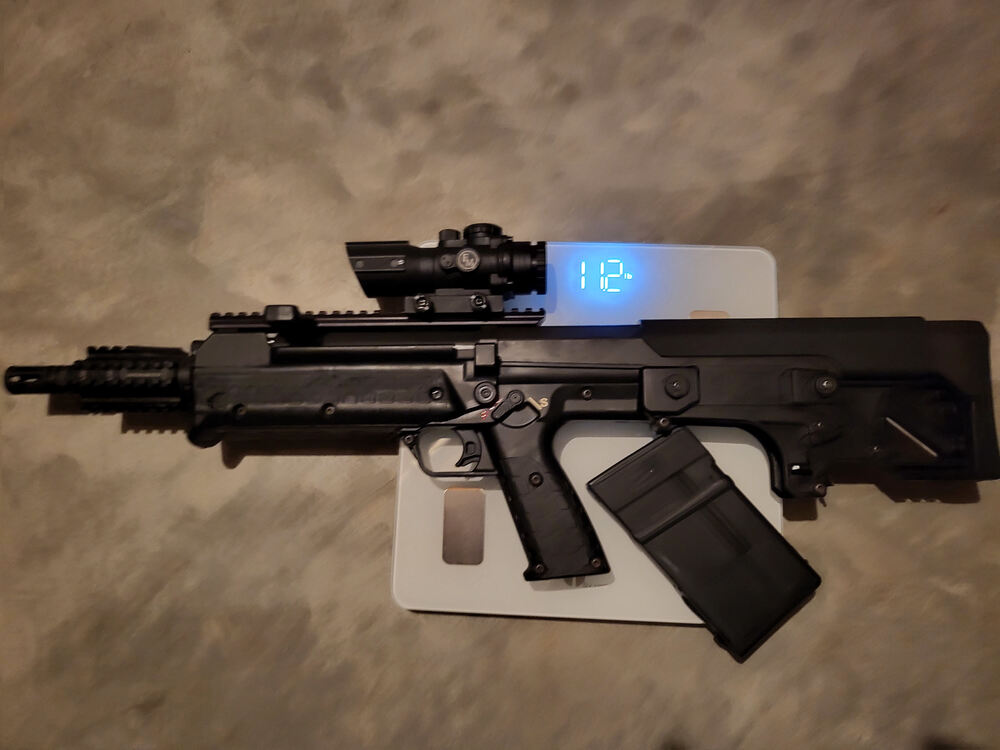 The RFB is a heavy firearm.
The handguns were, curiously, not a problem. Of the 5 I own, three pistols already have maximum magazine sizes under 10 rounds – I could probably get larger, but they’d be comical, sticking out of the bottom of the grip like an Uzi mag – a 4th is a 6-round revolver; only one is a double-stack and came with 15-round magazines. Even so, the double-stack (a Walther PPQ) itself is legal, I just couldn’t bring the magazines into the state. If I want to shoot it, I’ll have to buy a 10-round – they do make them.
So in Minneapolis I went to Scheels which, if you’re ever in Eden Prairie, MN you absolutely must visit: it’s an outdoors store and an experience.

Armed with the best quality Internet Truths, I talked to the guys in the gun section about transporting my firearms via air, and both got assurances that it was actually less fraught than I expected, and also that California would send me straight to jail if I made any mistakes flying in with guns in my luggage. I ended up with two cases (because, as you know, many handguns come with sufficiently robust, lockable cases) and ended up swapping out the long case before it was all done.
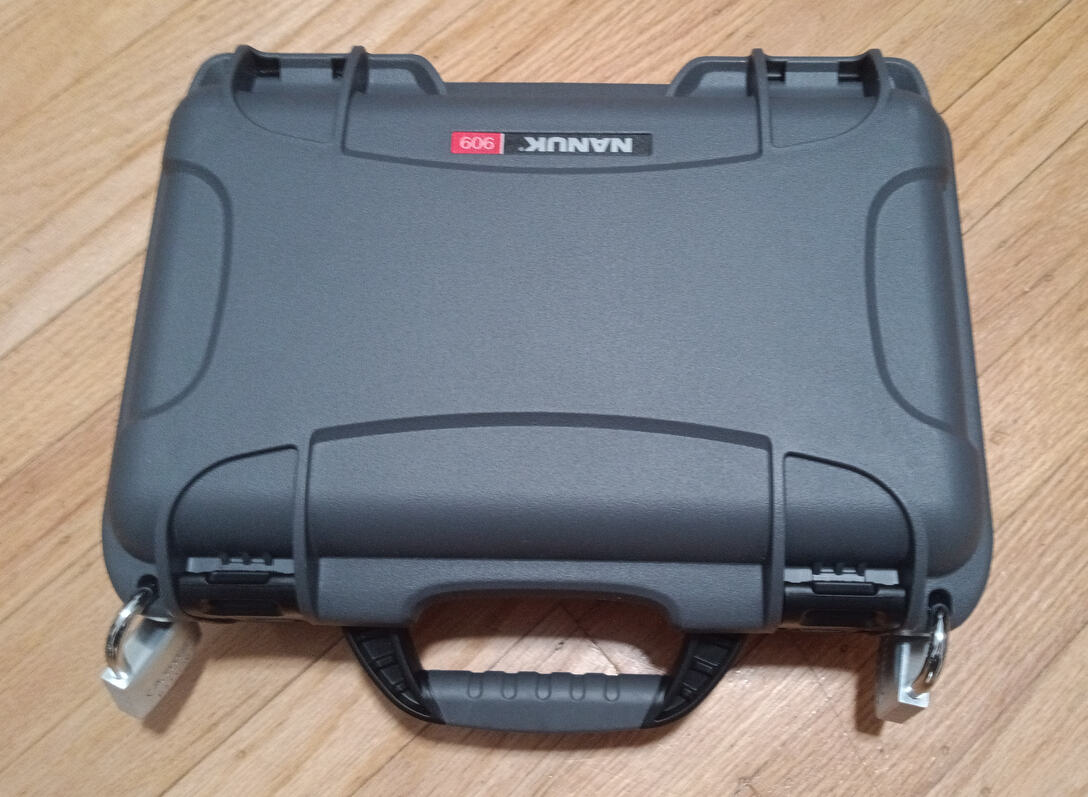
The long case is OK, but I’m really happy with the Nanuk 909. It was reasonably priced and feels high quality. It fit the two of my compact pistols which didn’t have acceptable travel cases. The Abloy Titalium locks can be had in 3-packs for $21 – they’re weatherproof, light, and fit the common lock hole sizes beautifully. And they’re Abloy, and I doubt you can get a better lock for the same price.
Now, what I ended up with was this: a large hard-sided luggage into which went the various (4) handgun cases, and one long gun case which held a lever gun and revolver: my cowboy case. One thing I learned was that Scheels still believes that gun case locks must be TSA-approved. However, from the TSA site I learned that TSA prefers gun locks not be open-able with the TSA keys. I don’t know if it’s just Scheels firearms salespeople or if it’s a general misconception, but in the end I locked everything with only non-TSA Abus locks and neither TSA in MN nor TSA in CA commented on it. It’s a better rule, IMO, as everybody and their brother probably has one of those TSA keys by now and if the goal is to minimize gun theft non-TSA locks are better.
Flying out was mostly easy; I checked in, told the attendant that I was traveling with firearms as you’re supposed to, and found the large item drop-off room. My advice is to fill out the forms before you head to the airport; it made it less stressful for me. The drop-off was all very chillaxed: they have a ginormous X-Ray machine and a few bored TSA employees talking about how they hadn’t gotten paid in a while because of the (at the time) government shut-down. My luggage ran through without comment, and they zip-tied and stickered everything up and I was on my way. Nobody asked me to open my cases, or really anything about the firearms. If how much time they take to read the images is any indication, the X-Ray tech was far more diligent than the ones in the regular checkpoint. I was flying late so it was only me and one other guy checking in oversized; if there’d been any line I would have been there forever.
Landing in CA was … not harder, but slower. I landed in the middle of the night and went down to baggage collection where the TSA office is. Long after all the other passengers had gotten their luggage and left, an employee accompanied by a TSA agent rolled out my bags, still stickered and zip-tied. The only question was about my identity; again, nobody asked me to open my luggage or asked any questions about the contents.
I can’t say whether my travel experience was typical, but based on what the Scheels guys said, it probably was. I felt far more nervous about the travel than was necessary, and even throwing California in there it was no trouble. Except that I ended up waiting over an hour for my baggage at the destination, but then, so did the guy who checked his golf clubs.
Once in California, you’ve got a month to register with the county; this is done through the California Department of Justice, and this is where the fun really began. First, out of the four states in which I’ve owned firearms, California is the only state where I had to register. You have to fill out forms and mail them in with a fee; you can list 2 firearms on each form, so I ended up needing 3. Now, it wasn’t clear to me whether the fee was per gun, per form, or per submission, so to be safe I submitted per form (as the fee was printed on each form). Well, that was wrong; the first response I got a couple of months later was a rejection for over-payment. The fee is absurdly, almost symbolically, small; maybe I should have written “keep the change” on it. But, no, I had to resubmit with the smaller, correct amount which only cost me time and postage. I’d say the postage ended up costing me more than if they’d just kept the original check, but that’d be an exaggeration.
The second response I got was a warning about assault rifles and a request for pictures of my long gun including a measuring tape clearly readable in the picture. The ominous wording mentioned the legal penalties for owning an assault rifle in California, and this was my first real experience in this whole journey where I understood where 2A advocates get uppity about California gun laws. Especially because the rifle in question was listed as an “unmodified, purchased new, Marlin 1895 45-70, 19” barrel, lever action”.
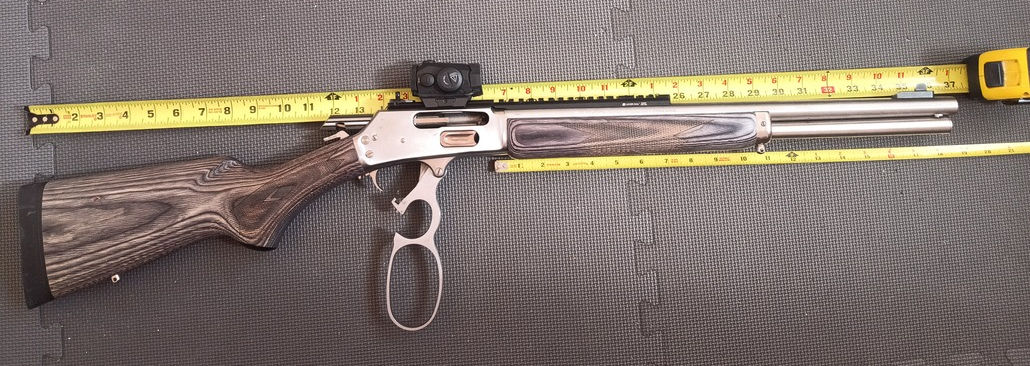
Now I don’t know what in that got someone at the California Department of Justice Bureau of Firearm Ownership thinking, “assault rifle!” but they did. I dutifully photographed and printed pictures (the above was one). After another month or so, I received another reply, this time with a confirmation of registration statement for each firearm.
I came out of this experience with a few thoughts. First is that California is not nearly as draconian about firearms as 2A people like to complain about. Yes, there are some limitations, but frankly I was surprised that of my 7 firearms, only one was restricted. Second, the registration process is tedious, but not particularly restrictive or onerous. Third, it’s kind of hilarious that anyone working for a firearms division would think a rifle marked as a “lever gun” would be a potential “assault rifle”. Finally, traveling with firearms is far less stressful than I expected it to be. Perhaps if I were traveling with ammunition it’d incur more questions, but I had 7 firearms in my luggage, traveling to California, and the hardest part of the whole adventure was wrangling the luggage itself. Guns are heavy.
If you’re planning to relocate to California and you have guns, my biggest take-away advice (beyond doing your travel and CA gun laws) is that your main import concern is magazine sizes and CA’s definition of “assault rifle”, which from what I can
Ah! I see you’re just about asleep! Well, I hope you enjoyed the story, and maybe you learned something from my experience! After all, California’s largest import is, arguably, people.